Home/The transfer coffin
The transfer coffinWhy a coffin for the journey is built differently
International requirements apply to cross-border repatriations. Airlines also require a hermetically sealed coffin.
Rudolf Nordheimer and team – in German, Russian or English.
Four layers, one purpose
The Council of Europe Agreement of 1973 on the Transfer of Corpses describes how a transfer coffin must be constructed. The core requirement: the coffin must be impermeable.
- 1Wooden outer coffinSolid walls – at least 20 mm for a double coffin, at least 30 mm for a single coffin.
- 2Soldered zinc linerThe inner zinc coffin is tightly soldered. It makes the coffin impermeable – the core requirement.
- 3Absorbent liningAn absorbent material inside is standard.
- 4Pressure-equalisation filterFor air freight, the coffin needs a pressure-equalisation device with a filter.
Sources: Council of Europe – Agreement on the Transfer of Corpses (1973) · Lufthansa Cargo – Transport of human remains
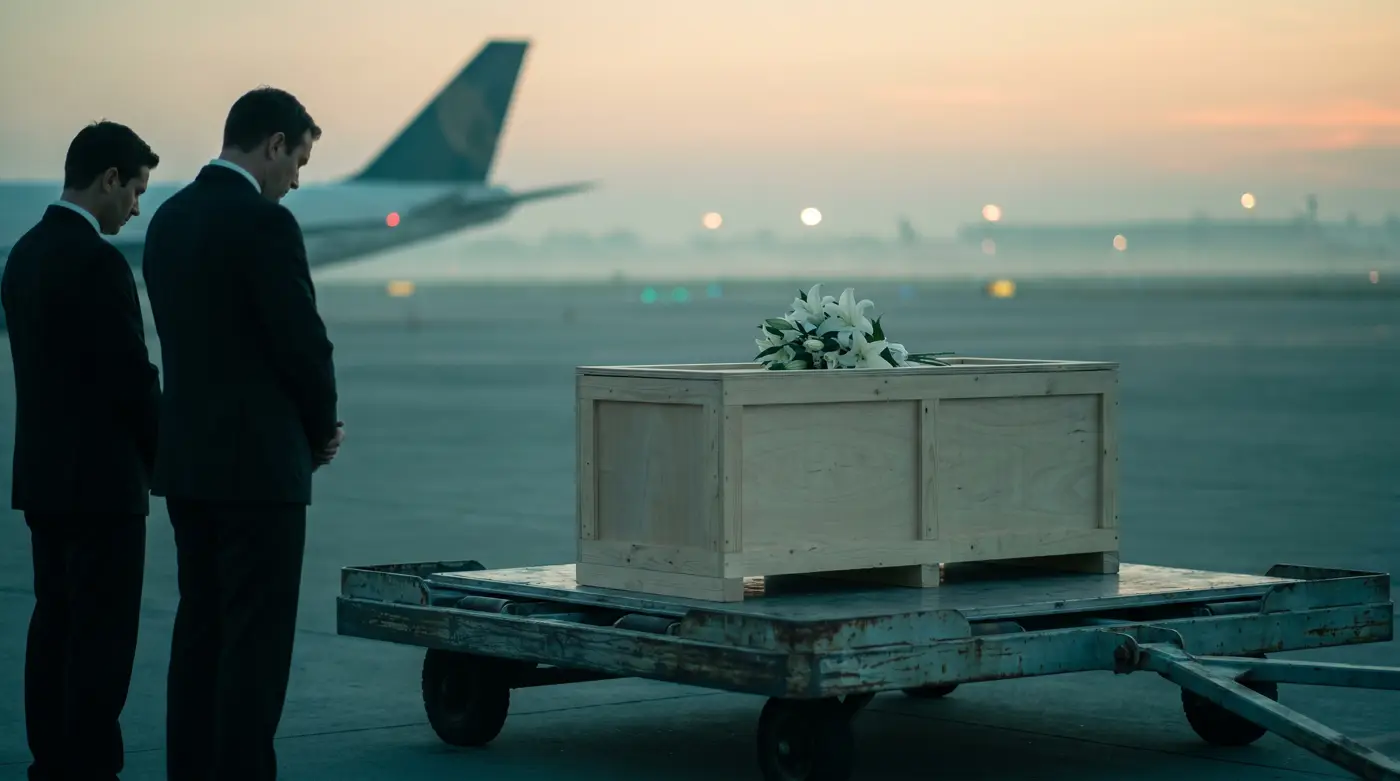
Zinc liner and air transport crate
The zinc liner is tightly soldered after the deceased has been prepared. For air freight, pressure equalisation must also be ensured. For the flight, the coffin travels in an air transport crate so that it is not immediately recognisable as a coffin in the cargo area.
Airlines also require a certificate of embalming or of preparation and soldering. Only funeral directors and specialised forwarders can book.
Sources: bestattungen.de – Repatriation abroad · Lufthansa Cargo – Transport of human remains
Hygienic preparation and embalming
Before the coffin is closed, the deceased is cared for with dignity. For long journeys, or if the airline or destination country requires it, embalming is necessary. We will tell you in advance whether this applies in your case.
Farewell before closing
A farewell at the coffin is possible before it is closed, in Germany or at the destination. Let us know early and we will plan the time. We will discuss with you which coffin is suitable for the burial at the destination.
Only the deceased and personal belongings that are to be buried with them may be placed in the coffin.
Frequently asked questions
Your question isn’t here? Call us – we will answer right away.
All questionsIs a zinc-lined coffin required for repatriation abroad?
For cross-border repatriations, usually yes. The European Agreement on the Transfer of Corpses requires an impermeable coffin: a wooden coffin with a tightly soldered zinc liner, absorbent lining and, for air freight, a pressure-equalisation device with a filter. Airlines also only accept hermetically sealed coffins. We provide a transfer coffin that meets these requirements.
What is an air transport crate?
The air transport crate is a wooden transport box in which the coffin travels as air freight. It protects the coffin during loading and ensures that it is not immediately recognisable as a coffin in the cargo area. At the destination, the coffin is taken out of the crate and handed over to the family or funeral director.
Does the deceased have to be embalmed for repatriation?
That depends on the route, the airline and the destination country. For air freight and long journeys, airlines often require a certificate of embalming or of hygienic preparation and soldering. We clarify in advance what is needed in your case and tell you before any costs arise.
Can we say goodbye before the repatriation?
Yes. A farewell at the open coffin is possible before it is closed and soldered – in Germany or, depending on your wishes and the condition of the deceased, at the destination. Let us know early, and we will plan the time and space for it. We are also happy to organise a funeral service before departure.
Is an urn transfer simpler and cheaper?
Yes. After a cremation, there is no need for a transfer coffin with a zinc liner, and the urn can travel as air freight or, in many cases, even in hand luggage. This makes the transfer simpler and considerably cheaper: with us, an urn transfer starts from €850. We are happy to discuss with you whether cremation suits the family’s wishes and the rules of the destination country.
We are here for you now
Day and night, including weekends. One call is all it takes to get the repatriation under way.