How much does coffin repatriation abroad cost?
The price of a coffin repatriation depends mainly on four things: the route, the mode of transport (funeral transport vehicle or air freight), the documents required by the destination country, and the place of collection. On top of that come the transfer coffin with a soldered zinc liner, hygienic preparation and, for air freight, the air transport crate and freight charges. A coffin repatriation therefore costs considerably more than an urn transfer. A reliable price can only be given once the route and paperwork are clear. We give you a free, written fixed price in advance, listing every item separately – with no extra charges later.
How long does a coffin repatriation take?
The duration depends mainly on how quickly the documents are available: death certificate, body passport, releases and, where applicable, confirmation from the consulate. Within Europe, the coffin is on the road in the funeral transport vehicle for one to a few days, depending on the route. With air freight, flight connections also play a role. An example from our reviews: for a repatriation from Munich to Novosibirsk, the burial was possible on the fourth day. It is not always that quick – after our first conversation we will tell you what you can realistically expect.
Is the coffin transported by plane or by car?
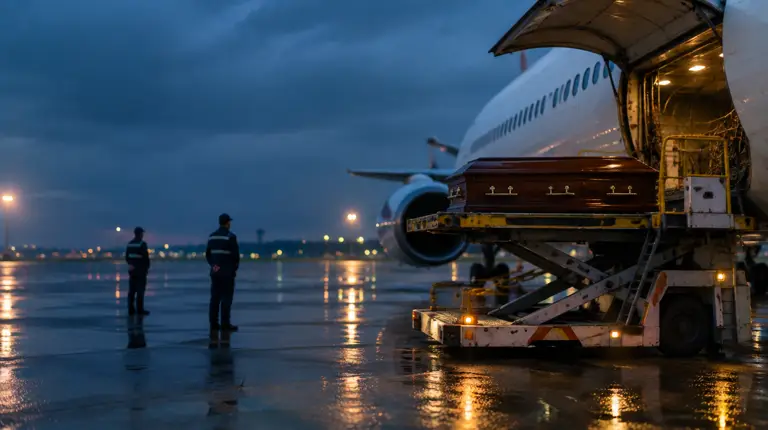
Both are possible. Within Europe – for example to Poland, the Baltic states, Italy, Croatia, Greece, Bulgaria or Ukraine – a funeral transport vehicle often drives door to door without reloading, and this is frequently cheaper. To the CIS countries, to Africa – for example Nigeria, Ghana, Cameroon or the Democratic Republic of the Congo – to Asia – for example Thailand, Vietnam or the Philippines – or to the Americas, the coffin travels as air freight in an air transport crate and is collected at the destination airport. Which route makes sense depends on the destination, time frame and budget. If both are possible, we calculate both options for you.
Is a zinc-lined coffin required for repatriation abroad?
For cross-border repatriations, usually yes. The European Agreement on the Transfer of Corpses requires an impermeable coffin: a wooden coffin with a tightly soldered zinc liner, absorbent lining and, for air freight, a pressure-equalisation device with a filter. Airlines also only accept hermetically sealed coffins. We provide a transfer coffin that meets these requirements.
What is a body passport and who issues it?
The body passport (Leichenpass) is the official accompanying document for a deceased person being transferred across a national border. In Germany, it is issued by the local public order office at the place of death, in accordance with the funeral law of the respective federal state. Among other things, the medical certificate of death and the death certificate are required for it. A coffin coming to Germany from abroad must also be accompanied by a body passport or a comparable document. We apply for the body passport on your behalf.
Which documents are needed for repatriation abroad?
As a rule, you need the death certificate – often as an international, multilingual certificate for use abroad – the doctor’s medical certificate of death, the body passport and a certificate of preparation and soldering of the coffin. In the case of an unnatural or unexplained death, release by the public prosecutor is also required. Many destination countries also require documents for the consulate, translations or an apostille. We obtain all documents for you; you only sign what is necessary.
Can we say goodbye before the repatriation?
Yes. A farewell at the open coffin is possible before it is closed and soldered – in Germany or, depending on your wishes and the condition of the deceased, at the destination. Let us know early, and we will plan the time and space for it. We are also happy to organise a funeral service before departure.
 By road